

Dr. David Kahn is an esteemed author who’s book The Codebreakers is widely acknowledged as the most comprehensive book ever written on the history, art and science of codebreaking. In addition to being an author of renown, he also had one of the world’s rarest collections of books, papers and artifacts related to the art and science of cryptology. We are extremely gratified to say that much of that collection is now the prized possession of the NCM and Library.
Since 2004 Dr. Kahn has made three large donations to the Foundation comprising well over 150 boxes of personal papers, manuscripts and rare memorabilia. Among the more significant items from his earlier donations were the first book ever published on codes and ciphers; the entire set of Dr. Kahn’s original manuscripts for The Codebreakers; rare advertising posters from old movies with intelligence and espionage themes; and, an old German-made hand-held cipher substitution wheel. We also received dozens of rare first edition books on cryptology, many personally inscribed by the authors to Dr. Kahn.
The centerpiece of his latest donation was an original carbon copy of Herbert Yardley’s editor’s manuscript for The American Black Chamber. Written in 1931 this book provided details of America’s first peacetime cryptanalytic organization, MI-8, the forerunner of today’s National Security Agency. Other significant items included uncorrected proof copies of Dr. Kahn’s books Kahn on Codes and Hitler’s Spies; numerous English and foreign language pamphlets on cryptology from the late 1800s and early 1900s; and, many commercial books and pamphlets on cryptology and secret writing written immediately before and during World War II.
A number of Dr. Kahn’s donated items are already on display at the NCM or available for review in the Museum Library. The picture below shows Dr. Kahn bequeathing his latest donation to Dave D’Auria, the Chairman of the Foundation’s Acquisition Committe. The house in the framed picture in the background was Dr. Kahn’s boyhood home. The room on the extreme left is where the Codebreakers was written.

The National Cryptologic Museum recently added two very rare five-rotor Hebern cipher machines to its collection (pictured below). The Hebern Electric Company built what is acknowledged to be the first five-rotor cipher machine in the 1920's (a number of others were designed independently about the same time). Although this machine was never widely manufactured or used, it is cryptologically significant as part of the overall evolution in U.S. manufactured rotor devices. We believe these two five-rotor machines are the only two that have survived. Financial assistance to acquire the Heberns came from an anonymous donor.
Trench codes were used for secrecy by field armies in World War I (WW I). The French pioneered the initial development of trench codes in 1916 followed closely by the Germans. U.S. Army Captain Howard R. Barnes was a pioneer in the rapid production and distribution of trench codes used by U.S. field armies.
Through the generous donation of a former U.S. Navy cryptologist, Terry Valois, the Foundation recently acquired a large scrapbook of personal papers, books and artifacts of Captain Barnes.
The scrapbook included: a "Front Line Code Book" marked SECRET #11902 with a list of two letter digraph codes to be used for communications to and from the trenches; a "MOHAWK Code" code book marked SECRET with a list of four number dinomic codes to be issued to all combatant troops down to Battalion; an Emergency Digraph Code list marked SECRET to be used with the "HURON CODE" for inter-division level communications; and, a pamphlet governing the regulation, distribution care and use of trench code books.
Other significant items included a 28x40 WW I Reconnaissance map of allied-occupied Coblenz Germany listing and plotting the location of all U.S., British and French troops and units, and an 8x11 hardbound book: THE FIRST BATTALION (the Story of the 406th Telegraph Battalion, Signal Corp, USA) Copyright 1921. The First Battalion was recruited entirely from Bell Telephone telegraph workers in Pennsylvania. This book tells their entire story. Pictures of select items from Captain Barnes collection are included below.
![]() WW I Mohawk Trench Code |
![]() WW I Emergency Code List |
![]() WW 1 First Telegraph BN History |
Navy Captain Laurance Safford is often referred to as the “father of U.S. naval cryptology”. His contributions during WW II were numerous and significant. Through the quick thinking and generosity of Mr. Robert Frey the Foundation received two file boxes of personal papers and documents that belonged to Capt. Safford. Mr. Frey acquired the documents from the Riggs Bank while doing research on the last flight of Amelia Earhart. Capt. Safford had written an unpublished manuscript on Earhart’s last flight. The manuscript was part of his estate and Riggs Bank was the executor (Capt. Safford apparently had no remaining heirs at the time of his death). Mr. Frey literally rescued the documents from a trash barrel at the Rigg’s storage facility where for some unexplained reason they were about to be trashed.
The donated papers included a number of personal letters written by Capt. Safford regarding events surrounding the congressional investigation into the attack on Pearl Harbor. One letter refers specifically to the “Winds Message” reportedly intercepted by the U.S. days before the 7 December surprise attack. This infamous message reportedly gave clear indications of the planned Japanese surprise attack. Unfortunately the actual intercept mysteriously disappeared shortly after the surprise attack and the Winds Message very existence is only supported by the testimony of Safford and perhaps one or two others who reportedly also were aware of the intercept.
The papers also included a four page letter from Capt. Safford to Vice Admiral C.E. Rosendahl responding to two pages of questions from Rosendahl about the number, distribution, disposition and construction of PURPLE machines prior to the attack on Pearl Harbor. Other documents included a petition to the Congress and supporting testimony to award Capt. Safford remuneration for his many secret cryptologic inventions, some of which were cited as among the most important and secure communication systems used by the U.S. during WW II. There were also numerous documents related to the life and subsequent disappearance of Amelia Earhart with whom Capt. Safford apparently maintained a fascination with up to the time of his death. In the below photo, Mr. Frey (on the left) is receiving a thank you letter from former Foundation President MG John Morrison (ret).

Mr. Robert Frey & MG John Morrison at the NCM
A local Maryland family recently contacted the Foundation to donate the book Die Weltkriegs Spionage. This oversized hardback 690-page book was published in 1931 and appears to be a comprehensive history of spy techniques. The NCM Library already has this book so the Foundation will auction the book at the October General Membership Meeting. This book lists for about $250, and one recently sold on eBay for $150. Pictures of the cover and facing page are included below.

German Espionage Book, Die Weltkriegs Spionage
This book with stories and photos compiled by James Schlueter was reviewed in the Naval Cryptologic Veteran’s Association Spring 2011 newsletter. At the request of the NCM Librarian, the AC has ordered a copy direct from the author for $40.

The AC purchased this WW II- issue Radio Operator’s Information File (ROIF) at a North Carolina antique mall for $13. The ROIF contains detailed information on aircraft radio operation, signaling procedures, direction finding, on-board code systems, weather codes, and message authentication. Special operating instructions for signal flag panels, body signals, and the Gibson Girl radio (the AC purchased a Gibson Girl for the NCM in 2005) are also included.
Front Cover and Content Photos from the WW II Radio Operator’s Information File

Mr. Larry Tart, the author of “Freedom Through Vigilance: A History of the U.S. Air Force Security Service” recently donated the first three volumes of his work to the Foundation for the NCM Library. Larry served in the U.S. Air Force Security Service for twenty-one years, retiring in 1977 as a senior master sergeant. He played a major role in creating the NCM’s C-130 Aerial Reconnaissance Memorial dedicated at Fort Meade on Sept 2, 1997. His "FTV" work is divided into four volumes. I, II and III chronicle the U.S. Air Force Security Service SIGINT ground-site histories during the Cold War, and females in the USAFSS. When published, volume IV will address USAFSS airborne SIGINT reconnaissance operations. The comprehensive history also includes limited coverage of ESC, AFIC, AIA and AFISRA. A cover picture of the book is included below

Mr. Jay Cristol, author of the book “The Liberty Incident” recently offered to donate 24 copies of his book to the Museum for sale in the Museum Gift Shop. The NCMF Administrator contacted Mr. Cristol and suggested he donate the books to the Foundation instead for sale at upcoming Foundation programs, and at the next general membership silent auction. A request was made that he sign the books also to add to their value. Mr. Cristol has also offered to pay the shipping costs. The 2002 book, which focuses on the question “did the Israelis know they were attacking a U.S. ship", was written after 17 years of extensive research to include data acquired from NSA through FOIA requests. We are awaiting the books arrival. A cover picture of the book is included below.

In October the AC purchased five relatively rare first edition books related to cryptology, espionage and intelligence from a Massachusetts antiquarian bookseller for $84. The bookseller reduced the original sale price by 20%. One of the books was an uncorrected proof copy of “American Espionage: From the Secret Service to CIA”. Three books dealt with German Secret Service espionage activities and conspiracies in the U.S. during both WW I and WW II, too include German wireless operations. The last and perhaps the most interesting book was on “Spies and Scouts of the North and South” during the Civil War, too include the use of secret codes and ciphers. Inside leaf photos are included below.


On Wednesday 1 September BAE Systems donated an OUTBLAZE/MAILORDER computer server to the NCM. OUTBLAZE (the hardware) and MAILORDER (the software) were first produced in 1990 and together they served as the backbone for field data forwarding. 300 units were fielded and the one donated by BAE is believed to be the last one in use. This item will be an excellent addition to our IA and computer technology display. A picture of the device is included below.

NCM Curator Patrick Weadon accepts the OUTBLAZE
donation from BAE Systems project manager Joe Hoolihan
On 6 July the AC purchased an IBM 3380 hard disk drive from a western Maryland antique store for $145 plus tax. The antique dealer discounted the price from $249. The hard disk drive will make an excellent period and technology addition to our IA and computer exhibits. The disk drive purchase was pre-coordinated with the Museum curator.
Hard disk drives are an essential part of the computer revolution, allowing fast, random access to large amounts of data. The IBM 3380 was introduced in June 1980 and was the first computer to use a hard disk Direct Access Storage Device (DASD). The 3380 initially came in six models ranging in price from $81,000 to $142,000. It was the first gigabyte capacity hard disk drive. The base model stored 2.5 GB of data, and later models had extended storage of up to 20GB. IBM sold over 100,000 3380s generating tens of billions of dollars in revenue, making the 3380 one of IBM’s most successful products of all time. A company photo of the 3380 is included below along with a photo of the disk drive purchased for the NCM.

The AC recently purchased a 1960 Navy Blinker Code Light set from a New Hampshire antique dealer. The Hasbro toy was used to send secret messages, learn Morse code, and help to “develop a natural interest in code communications.” A Navy Blinker Code Lite set recently sold on eBay for $30. This one cost the Foundation $17. Pictures of the set are included below.

Navy Blinker Code Lite Set
The AC recently acquired a 1942 edition of Radio News Magazine from a New Jersey antique dealer. After a request from the AC Chairman the dealer donated the magazine to the Foundation. Most of the 280+ page magazine is devoted to the history of the U.S. Army Signal Corps. Radio News started publication in 1919, changed names a number of times over the years, and is known today as Popular Electronics. The November 1942 issue is full of Signal Corps stories and photos (color and black and white), and also has a number of great WW II-era radio-related ads. One of the most intriguing is a “Find Garcia” recruiting ad for the U.S. Army Signal Corps sponsored by Jensen Speech Reproducers. The “Garcia” in the ad is Garcia Calixto who led the insurrection against Spanish rule in Cuba.
After the sinking of the USS Maine in Havana harbor, President McKinley composed a message of support to Garcia who was hiding somewhere in the Cuban mountains. Facing war with Spain, President McKinley wanted to know the disposition of Spanish forces in Cuba and the status of allied insurgent forces. He was told that U.S. Army Leftenant Andrew Rowan could be relied upon to deliver the message. Lt. Rowan took the letter and accepted the assignment with a “consider-it-done” attitude. He asked no questions, landed in Cuba at night and somehow, on foot in hostile and unfamiliar territory, found Garcia and completed the mission in three weeks. Lt. Rowan is often referred to as the real hero of the Cuban War.
The subsequent story of “A Message To Garcia” has been translated into almost every major language and has become one of the most published stories in the history of printed word with over 100 million copies in print. It is widely used in both theological teaching (will you carry a message for God without question?), and in recruiting (we’re looking for a few good men who can work independently and be relied upon to complete a task without asking 100 questions!). Who could have know that a simple ad and recruiting poster for the U.S. Army Signal Corps would have such profound meaning and worldwide impact. The Radio News cover and the ad are pictured below.

November 1942 Radio News Signal Corps Issue and Find Garcia Ad
A Vietnam War-era North Vietnamese KMZ-750 motorcycle on loan from Foundation member George Mele was moved into the Museum’s Vietnam exhibit in December 2008. The motorcycle is an integral part of a significantly redesigned Vietnam exhibit. The on-loan motorcycle is equipped with communications gear used by the North Vietnamese and Vietcong during the Vietnam War, and came with two North Vietnamese flags also on loan.
The KMZ 750’s history dates back to 1939 Stalinist Russia. They were produced for over 50 years evolving into the KMZ 750—by now nicknamed simply “molot” the Russian word for hammer. They were used extensively by the North Vietnamese Army throughout the 1960s. At least 3,000 were shipped from Odessa to Haiphong and used by the NVA as command, control, and communications/liaison vehicles in a tactical environment. They were the transportation-of-choice for junior officers who would monitor the progress of convoys, scout ahead for obstacles and ambushes, and report incidents and breakdown of cargo vehicles. Hundreds were used in the Tet Offensive buildup in 1967-68.
The NVA communicated on the trail using the then state-of-the-art Soviet R105 transceiver. This was a short-range and relatively low-power push-to-talk radio that was very difficult for our fixed collection facilities to intercept and exploit. However, our sensitive AN/TRD 15 and high frequency direction finding (HFDF) equipment was frequently able to hear and locate them with success. The Army Security Agency (ASA) and ARVN units using portable AN/PRD-1 DF sets were also able to hear and locate them. We also employed RU-21 and EC-47 airborne intercept and direction finding aircraft to locate and track the HF and low-VHF communications with excellent results. Pictured below are NCMF benefactor George Mele (L) with NCM curator Patrick Weadon, and Acquisition Chairman Dave D'Auria during the motorcycle installation.j
Former USA Security Agency LTC Burt Slesinger (retired) recently donated eight post WW I US War Department training manuals to the NCM library. The AC Chairman stopped by Burt’s home in Melbourne, Florida to pick-up the items. The manuals contained detailed information on German Military Ciphers, Field Codes, and Military Liaison and Intelligence activities during the war. The items came from the collection of former ASA Col John Mcfadden (retired). Front cover photos of two of the manuals are included below.

Retired ASA’er Bill Roscher recently donated a working condition Super-Pro receiver from WW II. The Super-Pro was made by the Hammarlund Company and carried the military designators of BC-1004, BC-794, and BC-779. It was the workhorse radio of the Army Signal Corps during WW II and saw extensive use in every military theater. They were manufactured through at least 1945, and possibly as late as the early 1950s. Thousands were delivered. The Super-Pro was eventually replaced by the venerable R-390 URR receiver used by, inter alia, the AC Chairman during his SCE and early Agency career. The NCM curator has accepted the Super-Pro for possible use as a period piece in a future WW II display. A commercial ad for the Super-Pro is included below.

Another former ASA’er Bob Clay recently donated the battalion flag of the USA Security Agency unit at Rothwestern, Germany. The US Army-Air Force took over the base at Rothwestern in 1945, and it remained a U.S. run installation until it was returned to the German Bundeswehr in 1975. During the Cold War the 319th USASA Battalion was responsible for an area that stretched from the Baltic Sea to Southern Germany and from near the Dutch border to the East-West German border. The 319th Battalion had Company level units at various locations throughout Germany. The ASA unit at Rothwestern was a main intercept and MARBURG- equipped special identification techniques (SIT) site during the Cold War. It was also a mainstay of the European direction finding (DF) network. A picture of the 319th battalion flag is included below.

Our acquisition interests are not just limited to rare cipher machines and books on cryptology. In the recent past we have acquired many artifacts of unusual interest. They include a rare WW I Army Signal Corps poster; a rare Jedburg Silk used by Special Operations Element units to communicate with London HQ during WW II; 80 photographs of a WW II era Code Room in Washington D.C.; four first day stamp covers issued by the UK to memorialize Bletchley Park; two rare bronze and copper Chinese cipher locks that use combinations of Chinese words to open the devices; and a U.S. first day cover stamp of the German Enigma machine issued to commemorate the work of U.S. and allied cryptologists during WW II. Some of the unusual items acquired since 2007 are depicted below.

Four Bletchely Park reports on Enigma and codebreaking donated by David Hamer

Six books requested by the NCM Librarian and donated by our London benefactor Tim Robarts.

WWII Liberty Bond Poster WWII Nazi Flag Czech Poster
Donated by Tim Robarts German History of Espionage
![]() WW II Security Poster |
![]() Commercial Speech Scrambler |
![]() WW II German Printer/Fax |
![]() Underwater Encrypted Radio |
![]() Racal Data Encryptor |
![]() Polaris Missile Permissive Action Lock |
![]() WW II German Krypto-Fon |
![]() WW I Comms Poster |
![]() WW II Japanese Field Phone |
![]() BEDROCK Polaris Missile Radio |
![]() Clandestine Suit-Case System |
![]() Long Dwell Collection Recorder |
![]() Clandestine Spread Spectrum Transmitter |
![]() VHF Bugging Receiver |
(Type used on Air Force One) |
![]() WW II Security Poster |
![]() WW II Minerva Tropics Radio |
![]() WW I U.S. Army Field Phone |
![]() 1950s Crayola Cipher Board Game |
![]() Soviet Flag From Votinsk Facility |
![]() Manual Morse Training Course |
![]() Civil War Torch Fuel Canteen |
![]() WW II Nazi Banner |
![]() 1960s Minox Spy Camera |

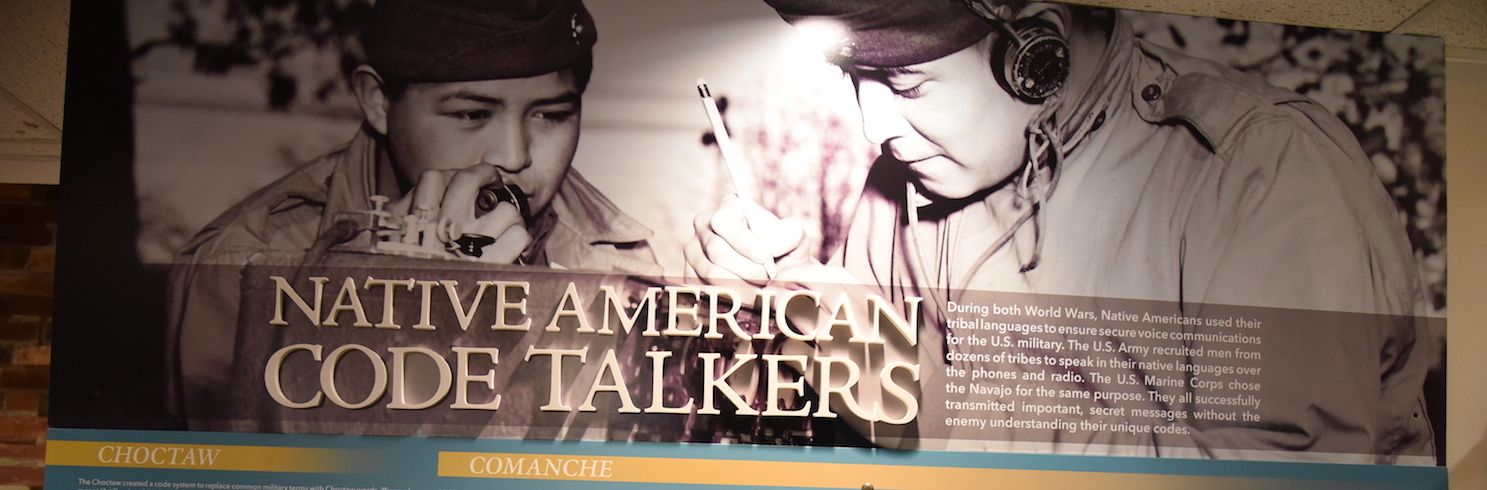
Military storage trunk with Garod TBX-8 radio and accessories built for wartime use by native American Indian code talkers

TBX-8 Navajo Code Talkers Radio
![]() |
![]() |
![]() |
Carlos Van Orden, a career Western Union employee, recently contacted the AC to donate his library of Western Union Technical Journals to the Museum Library. The collection covers the period from 1947 through 1964, and comprises a fascinating time capsule on the march of telecommunications technology during the period. Some of the more pertinent journals include articles on ocean cables, teleprinter codes, global telegraphy, telex in the USA, cable laying ships, AUTODIN, the modernization of military communication systems, and the 100th anniversary of the Atlantic undersea cable. The donation also included a packet of information on ASR-28 teletype machines. This model teletype is similar to at least one we have in our Museum inventory
The AC recently purchased a U.S. Service Issue Pocket Signal Disk at a Georgia antique mall for $4. The two-sided pocket size primer has the International Morse Code one one side, and the Semaphore International Flag Code System on the reverse. The original price for the primer was .30 cents. This item will be donated to the NCM. Pictures of the Signal Disk are included below.
U.S Service Issue Pocket Signal Disk for International Morse and Semaphore Flag Codes
![]() |
![]() |

DIG FOR VICTORY (increase food production); HITLER WILL SEND NO WARNING (carry your gas masks); BRITAIN SHALL NOT BURN (fire bomb defense); and KEEP MUM, SHE’S NOT SO DUMB (beware of spies).
![]() Clandestine Burst Encoder |
![]() Soviet Bloc Burst Encoder |
![]() WW II Omaha Beach Landing Map Marked Secret |
![]() Civil War Era Telegraph Key |
- Last Updated - 1/26/12
-Nash Letters on Display at NCM
-December Link in Members Only
-Call for 2012 Hall of Honor Candidates
-Gen Hayden on the Future of Things Cyber
Olga Kripner
NCMF on Facebook & Twitter